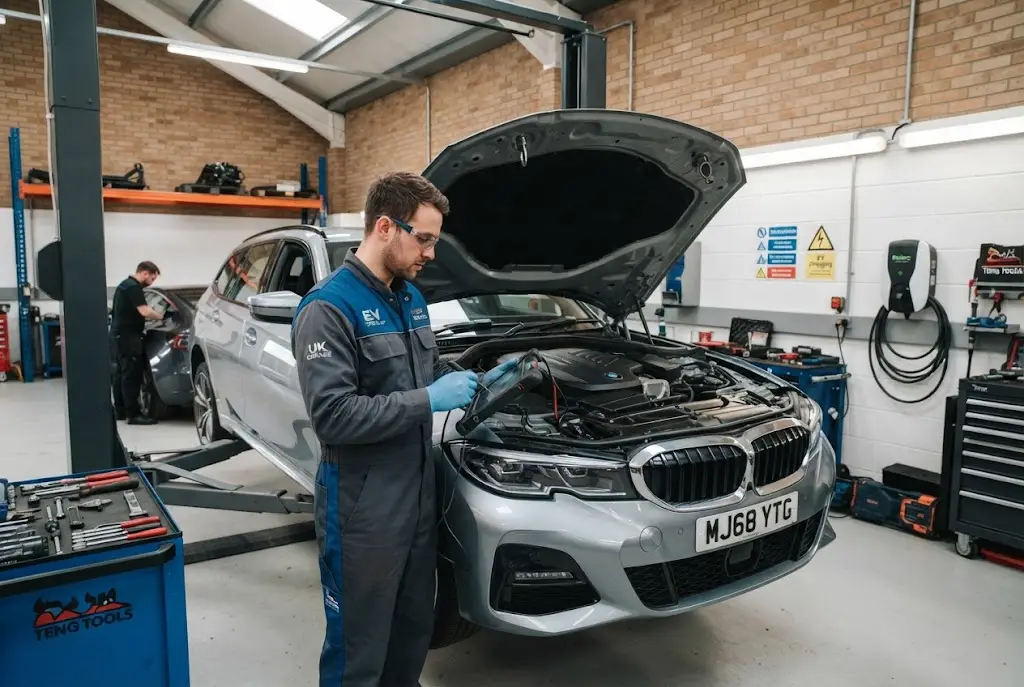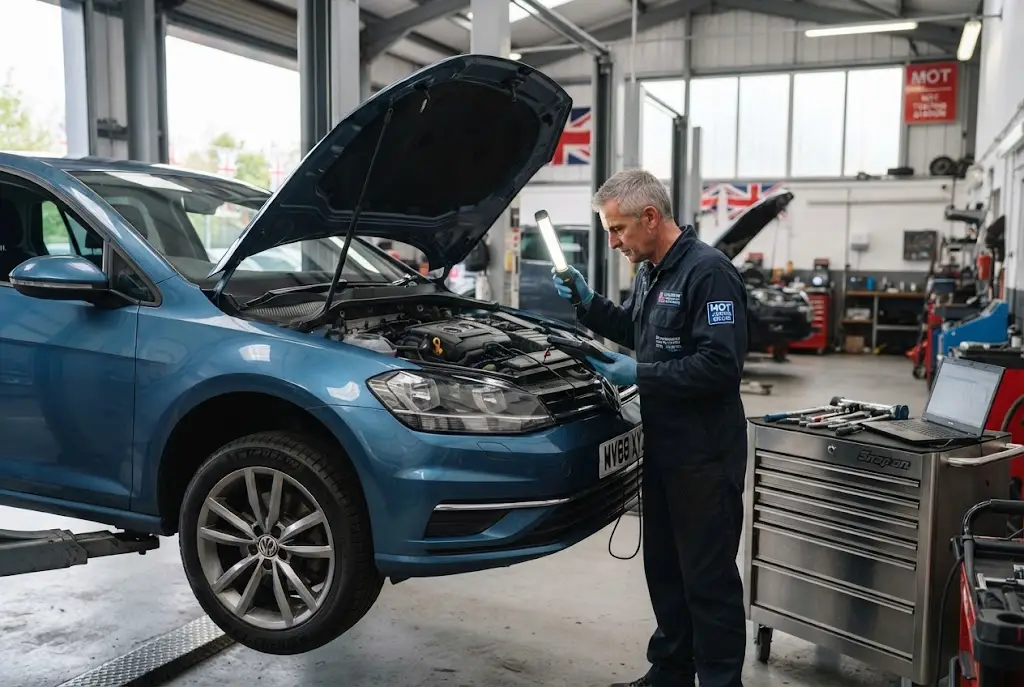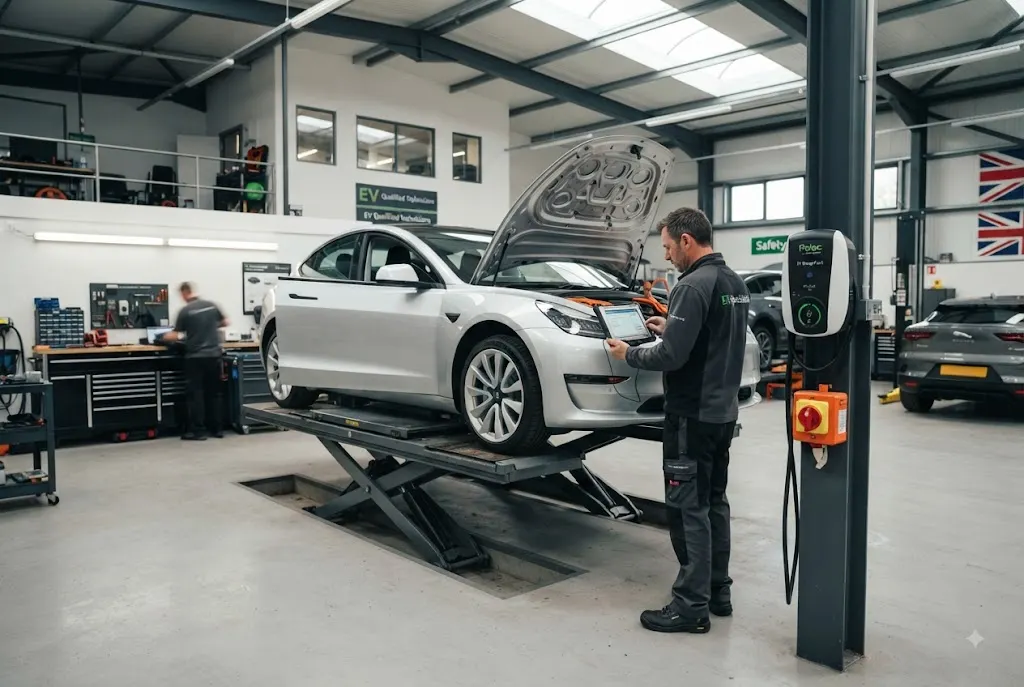
EV servicing is becoming a normal part of vehicle ownership in the UK as more motorists switch from petrol and diesel cars to fully electric vehicles. Although electric cars have fewer moving mechanical components than conventional vehicles, they still require regular inspections and maintenance to remain safe, reliable and efficient.
Electric vehicle maintenance focuses heavily on the battery, high-voltage electrical systems, charging equipment, brakes, tyres, suspension, steering, software and other safety-critical components. As the UK’s EV fleet grows, workshops are also adapting their equipment and technician training to meet these new servicing requirements.
What Is EV Servicing?
EV servicing is the inspection and maintenance of an electric vehicle’s mechanical, electrical and electronic systems. The exact checks vary according to the manufacturer and model, but an electric car service can involve considerably more than simply checking the battery.
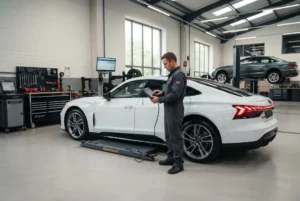
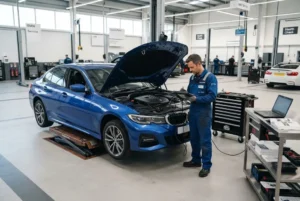
Technicians may inspect high-voltage components, battery and charging systems, braking components, steering, suspension, tyres, lights, safety systems and onboard electronics. Diagnostic equipment can also be used to identify faults recorded by the vehicle’s electronic control systems.
RAC’s current electric-car servicing guidance highlights checks of high-voltage systems, battery health, charging equipment and regenerative braking alongside conventional safety and mechanical inspections. :contentReference[oaicite:0]{index=0}
This means EV owners should not assume that an electric car is maintenance-free. The maintenance profile is different from a petrol or diesel vehicle, but regular servicing remains important.
Why EV Servicing Is Different
Electric vehicles do not have many of the components found in conventional cars. There is no traditional engine oil to replace, and there is no conventional exhaust system or engine with hundreds of internal moving parts.
However, EVs depend on sophisticated electrical and electronic systems. The high-voltage battery supplies energy to the electric motor, while inverters, wiring, connectors and control systems manage the flow of electricity.
These components require specialist knowledge. A technician working on high-voltage systems must follow appropriate safety procedures and use suitable equipment. Drivers should therefore choose a workshop with the relevant EV training rather than assuming that every general garage can perform every type of electric-car repair.
What Does an EV Service Include?
The contents of an electric vehicle service depend on the manufacturer, vehicle age and service schedule. Nevertheless, several areas commonly deserve attention.
Battery and Charging System Checks
The traction battery is one of the most important components in an EV. A service can include checks of battery-related systems, charging equipment and warning information recorded by the vehicle.
Battery condition can affect driving range and vehicle performance. However, drivers should not assume that a gradual change in range automatically means the battery is failing. Temperature, driving style, tyre pressure, traffic and use of heating or air conditioning can all affect real-world range.
Modern EVs also use sophisticated battery management systems to monitor temperature, charge levels and electrical performance. Appropriate diagnostic equipment can help technicians identify problems that may not be visible during a simple visual inspection.
High-Voltage System Inspection
High-voltage components require particular attention because they are fundamental to the vehicle’s propulsion system. Depending on the model and service procedure, technicians may inspect relevant cables, connectors, insulation and other components.
These systems should only be handled by appropriately trained professionals. Owners should never attempt to open or repair high-voltage battery systems themselves.
Regenerative Braking
Regenerative braking allows an EV to recover some kinetic energy when the vehicle slows down. Instead of relying entirely on conventional friction brakes, the electric motor can help decelerate the car while converting some energy back into electrical energy.
Because regenerative braking can reduce the use of friction brakes, pads and discs may experience different wear patterns compared with conventional vehicles. That does not mean the brakes can be neglected. They still need inspection and must remain in good working condition.
Tyres and Wheels
Tyres remain an important maintenance item for electric vehicles. EVs can be relatively heavy because of their battery packs, while instant electric torque can place additional demands on tyres depending on driving style.
Drivers should check tyre pressure and tread regularly and look for uneven wear or visible damage. If the vehicle develops steering or handling problems, a workshop should investigate the cause rather than simply replacing the affected tyre.
Steering and Suspension
Electric cars still depend on conventional steering and suspension components. Bushes, dampers, springs, joints and other components can wear over time.
A professional service can identify issues before they develop into more serious problems. This is particularly important for vehicles that regularly carry heavy loads or travel on poor road surfaces.
How Often Should an Electric Vehicle Be Serviced?
There is no universal EV service interval for every model. Manufacturers establish their own schedules based on vehicle design, battery technology and operating requirements.
RAC states that many manufacturers recommend an electric car service approximately every 12 months or 10,000 to 20,000 miles, whichever comes first, while also stressing that drivers should check the individual vehicle handbook because intervals vary. :contentReference[oaicite:1]{index=1}
The best approach is therefore to follow the manufacturer’s schedule rather than relying on a generic mileage figure.
Some electric cars may use digital service reminders rather than traditional paper service books. Owners should retain digital records, invoices and reports so that there is a clear history of maintenance.
EV Mechanics Need Different Skills
EV mechanics need a combination of conventional automotive knowledge and specialist electrical expertise. Although many maintenance tasks remain familiar, high-voltage systems introduce additional safety and diagnostic requirements.
Training is becoming increasingly important across the UK automotive sector. Government apprenticeship listings in 2026 continue to show demand for vehicle service and maintenance technicians, with training programmes covering modern vehicle technology. :contentReference[oaicite:2]{index=2}
For workshops, investment in training can be just as important as purchasing new equipment. A garage may already have years of experience servicing conventional vehicles but still need additional qualifications and procedures before taking on high-voltage EV work.
This is one reason the wider growth of automotive service companies is relevant to EV owners. Large networks and independent garages alike are having to adapt as the UK’s vehicle fleet changes.
Battery Servicing: Does an EV Battery Need Replacing?
Battery servicing is often misunderstood. An EV battery does not necessarily need replacement simply because the vehicle has lost some range over time.
Battery capacity naturally changes with use and age, but the condition of an individual battery depends on its chemistry, thermal management, charging patterns, vehicle design and operating conditions.
A 2026 UK study reported by RAC analysed battery health data from 8,000 electric cars across 36 brands. The research found an average state of health of 95% across its sample, including vehicles up to 12 years old. :contentReference[oaicite:3]{index=3}
That finding should not be interpreted as a guarantee for every EV. Battery condition varies between individual vehicles. Instead, it demonstrates why proper battery-health assessment is more useful than assuming that an older electric car automatically requires a complete battery replacement.
When a battery-related problem does occur, the appropriate repair can depend on the vehicle and the nature of the fault. Owners should obtain a professional diagnosis before agreeing to an expensive replacement.
Charging Equipment Is Part of EV Ownership
Charging infrastructure is closely connected to electric vehicle maintenance. A car may be mechanically healthy but still be difficult to use if its charging equipment or charging connection develops a problem.
Drivers should periodically inspect charging cables and connectors for obvious damage. If a charging fault repeatedly occurs, the vehicle and charging equipment may both need investigation because the problem could originate from either side of the connection.
Home charging installations should also be carried out by appropriate installers. The UK Government provides an online service for finding chargepoint installers approved through the Office for Zero Emission Vehicles (OZEV). :contentReference[oaicite:4]{index=4}
Public charging infrastructure is expanding too, creating another maintenance requirement beyond the vehicle itself. Local authorities and other organisations are increasingly procuring services to maintain and repair charging points. For example, Edinburgh City Council awarded a contract in 2026 covering maintenance of its public and car-club EV charging points. :contentReference[oaicite:5]{index=5}
EV Ownership and Everyday Maintenance
Electric vehicles still require regular attention between professional services. Owners can perform several simple checks themselves without touching high-voltage components.
- Check tyre pressures regularly.
- Inspect tyre tread and visible damage.
- Keep the windscreen washer fluid topped up.
- Pay attention to brake performance and unusual noises.
- Monitor dashboard warning messages.
- Keep charging cables clean and free from visible damage.
- Follow the manufacturer’s battery and charging recommendations.
- Install important vehicle software updates where appropriate.
These checks do not replace professional servicing. They simply help owners identify obvious problems between scheduled appointments.
Software Updates Are Becoming Part of EV Maintenance
Software plays a much larger role in modern electric vehicles than it did in many older cars. Vehicle software can control charging behaviour, battery management, energy use, driver assistance systems and other functions.
Some manufacturers provide over-the-air updates, allowing certain software improvements to be installed without visiting a workshop. Other updates or diagnostic procedures may still require professional equipment.
Drivers should therefore keep track of manufacturer communications and follow instructions relating to important updates, recalls and technical campaigns.
Choosing the Right EV Mechanics
Finding suitable EV mechanics is one of the most important decisions for an electric-car owner. A convenient garage is not necessarily the right choice if it lacks the equipment or training required for the job.
Ask About EV Training
Before booking specialist work, ask whether technicians are trained to work on electric vehicles and high-voltage systems.
Check the Services Offered
Some garages may provide routine EV servicing but not high-voltage battery repairs. Others may specialise in diagnostics or particular vehicle brands. Confirm what the workshop can actually handle.
Compare Service Inclusions
Do not compare prices based only on the phrase “EV service”. Ask what checks are included and whether diagnostic work, battery inspection or other specialist procedures cost extra.
Consider Manufacturer Requirements
If the vehicle is under warranty, check the manufacturer’s servicing requirements before using an independent garage. Keep all documentation relating to the work carried out.
EV Servicing vs Conventional Car Servicing
There are important similarities between electric and conventional vehicle servicing. Both types of vehicle need safe tyres, effective brakes, functioning lights, steering and suspension components and properly maintained safety systems.
The main difference is the propulsion system. A conventional car has an internal combustion engine, exhaust system, fuel system and other components that an EV does not need. An electric vehicle instead depends heavily on a high-voltage battery, electric motor, inverter and sophisticated electronic controls.
This can mean fewer routine mechanical maintenance requirements, but it does not eliminate servicing altogether.
The distinction is particularly useful when comparing workshop prices. An EV may require fewer conventional consumables, but specialist diagnostic equipment and high-voltage expertise can still make certain repairs technically demanding.
EV Industry News and Workshop Demand
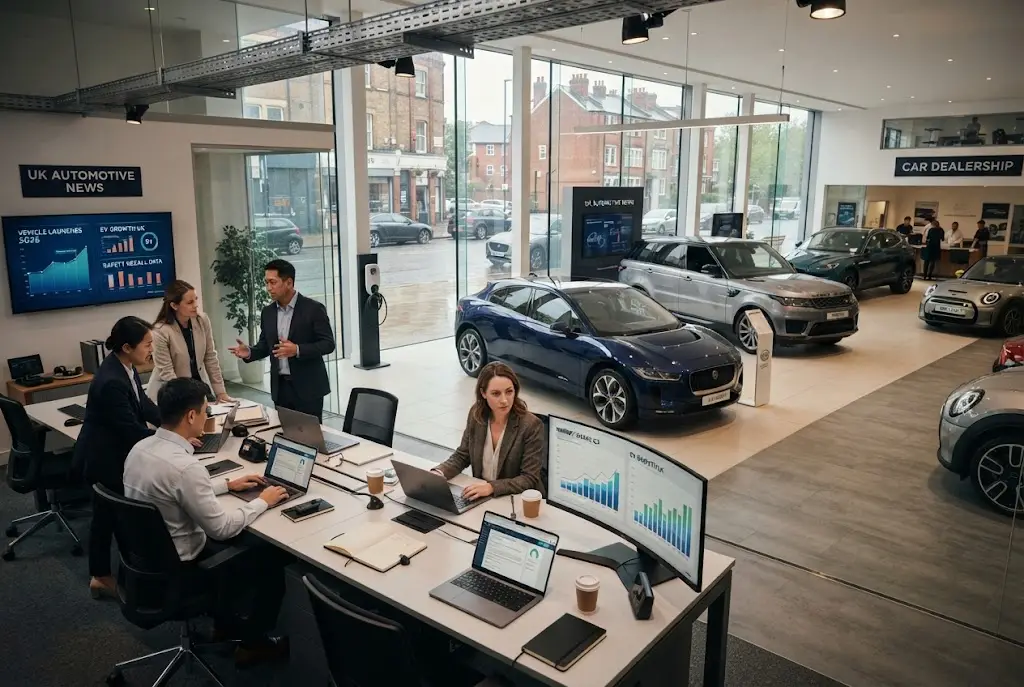
The expansion of EV ownership is creating new opportunities throughout the automotive service industry. Garages need qualified technicians, diagnostic equipment and safe procedures, while businesses involved in charging infrastructure require installation and maintenance capabilities.
The charging network itself is also evolving. Research reported in April 2026 found that 42% of responding councils across England, Scotland and Wales planned to have cross-pavement charging available by the end of 2026, potentially improving charging access for drivers without private driveways. :contentReference[oaicite:6]{index=6}
These developments matter to EV servicing because the ecosystem around electric cars is becoming broader. Vehicle workshops are only one part of a growing network involving battery diagnostics, chargepoint installation, electrical maintenance and digital services.
As the market develops, garage businesses that invest in EV expertise could be better positioned to serve motorists who are replacing conventional cars with electric alternatives.
What EV Owners Should Watch in 2026
Several areas deserve attention from UK electric-car owners during 2026.
First, battery health remains an important issue, particularly as more older EVs enter the used-car market. Buyers and owners may increasingly seek reliable battery-health assessments rather than relying solely on estimated driving range.
Second, charging infrastructure continues to expand. More home and public charging options can make EV ownership easier, but charging equipment itself needs appropriate installation and maintenance.
Third, workshop skills are changing. EV mechanics require specialist training, while general automotive technicians are increasingly expected to understand electrified powertrains.
Finally, motorists should continue to follow manufacturer service schedules. The fact that an EV has fewer moving parts does not mean that routine safety checks can be skipped.
How EV Servicing Could Develop
The future of EV servicing is likely to involve greater use of diagnostic software, battery-health testing and specialist electrical equipment. Workshops may also become more specialised as the number of electric models on UK roads increases.
Battery repair could become a particularly important area. Instead of treating every battery fault as a reason for complete replacement, specialist businesses may increasingly diagnose and repair individual components where the vehicle design and manufacturer procedures allow it.
At the same time, independent garages will have opportunities to compete with major garage chains by developing specialist EV expertise and building strong local reputations.
The wider market will probably include a mixture of manufacturer service centres, national workshop groups, independent EV specialists and general garages with suitable EV qualifications.
Final Thoughts on EV Servicing
EV servicing is an essential part of responsible electric vehicle ownership. While EVs generally have fewer conventional mechanical components, they rely on high-voltage batteries, electric motors, charging systems, electronic controls and sophisticated software.
Routine maintenance should therefore focus on the systems that matter most to the particular vehicle. Battery health, charging equipment, high-voltage components, regenerative braking, tyres, steering, suspension and safety systems all deserve appropriate attention.
For UK drivers, the best approach is to follow the manufacturer’s service schedule and choose technicians with suitable EV training for specialist work. Owners should also keep service records, monitor warning messages and deal with charging or battery concerns promptly.
As EV ownership continues to grow, the automotive aftermarket will continue adapting. Better battery diagnostics, wider technician training and expanding charging infrastructure should give motorists more options for maintaining electric vehicles safely and effectively.